Why Proper Motorcycle Boots Matter More Than You Think
Adventure riding boots are one of the most misunderstood pieces of motorcycle gear, yet they play a critical role in rider safety, control, and confidence. When choosing motorcycle boots for adventure riding, many riders focus on comfort and walkability, overlooking how proper motorcycle footwear affects fatigue, stability, and injury prevention—especially off-road. In this article, I break down what truly matters in adventure riding boots, how off-road motorcycle boots differ from so-called “adventure” options, and why the right boot can make you a better, safer rider both on and off the pavement.
So. WHAT BOOTS SHOULD I BUY?
The most common question I receive as a professional motorcycle riding expert is about equipment. Riders want to know what helmet to buy, which tires to run, how to set up their bike properly, and which riding suit is considered the best.
Much to their dismay, most of my answers begin with “it depends”. However, there is one subject where I am unapologetically firm, and this is footwear. This is a worthy subject for street riding, but once you leave paved roads for those less traveled (dirt, gravel, or even trails), the subject switches from a worthy one to a critical one.
Riders who sign up to ride adventure motorcycles or dual sport motorcycles with me are required to wear appropriate PPE (personal protective equipment). Any rider who trains or travels with me must be wearing the best protective boots they can reasonably tolerate. This is because I care about you – I really do. And I know that when a rider gets hurt off-road, it’s their feet and ankles that are disproportionately at risk for injury.
Unfortunately, it’s the newest riders to the unpaved world of ADV riding that are most likely to be wearing inappropriate boots. This is generally due to their belief their boots are protective (often due to advertising or bad advice from friends, Facebook groups, or forums) or they choose not to purchase proper protection because of perceived poor comfort, reduced mobility, or financial reasons.
I completed an Around the Wheel podcast with Brian Price, founder of Atomic Moto, to dig deeper into why boots matter so much, why good boots cost what they do, and how riders – especially adventure riders – can make better decisions around footwear. This article distills that conversation into practical guidance you can use as a reference.
BOOTS AREN'T JUST PROTECTION. THEY ARE A RIDING TOOL.
Most riders perceive boots purely as safety gear. That’s only part of the reason for using proper off-road boots.
A proper off-road or adventure-capable boot has four critical jobs:
- Protects your foot, ankle, and lower leg
- Supports your body weight while standing
A rigid boot upper allows you to clamp the bike with your lower legs, improving stability and control. - Reduces fatigue
A stiff sole doesn’t flex as much on the footpeg; this reduces foot fatigue when standing. - Improves bike control and rider confidence
A stiff boot feels more planted and predictable which increases confidence leading to smoother inputs—and fewer mistakes.
Prevention is the first step in protection. A rigid boot often makes you less likely to crash in the first place. The best part about choosing a stiffer, more protective boot is that the improvements in your riding mean you may need its injury-protection qualities less often.
QUALITY MOTORCYCLE BOOTS ARE OFTEN EXPENSIVE.
Years ago, when I was new to off-road riding, my wife bought me a pair of top-tier motocross boots. My initial reaction was disbelief: ‘They cost more than my helmet!’
At the time I didn’t understand the value or technology that goes into high quality off-road riding boots. Fast forward twenty years, and I now spend a lot of time making videos, podcasts, and writing articles to help others not make the same mistakes I did when I was new to this type of riding.
Here’s what I didn’t understand at the time, and what Brian explained clearly during our podcast together:
Motorcycle boots are incredibly complex
- A typical helmet contains around 50 parts
- A serious off-road boot can contain 150–200+ individual components
- Boots involve far more human labor than helmets, not just machine processes
High-end off-road motorcycle boots are generally manufactured in Italy, or nearby regions with skilled labor, strict manufacturing standards, and complex assembly steps. Buckles, hinges, soles, and protective panels all add cost, and all serve a purpose.
With off-road motorcycle boots, you truly get what you pay for. I tell riders if they are on a budget, that boots must be the first item on the list that receives the bulk of the budget. You can buy a budget helmet, and armored gear that will do the job, but when it comes to boots, there is always a compromise in protection as you move down in cost.
THE PROBLEM WITH 'ADVENTURE SLIPPERS'
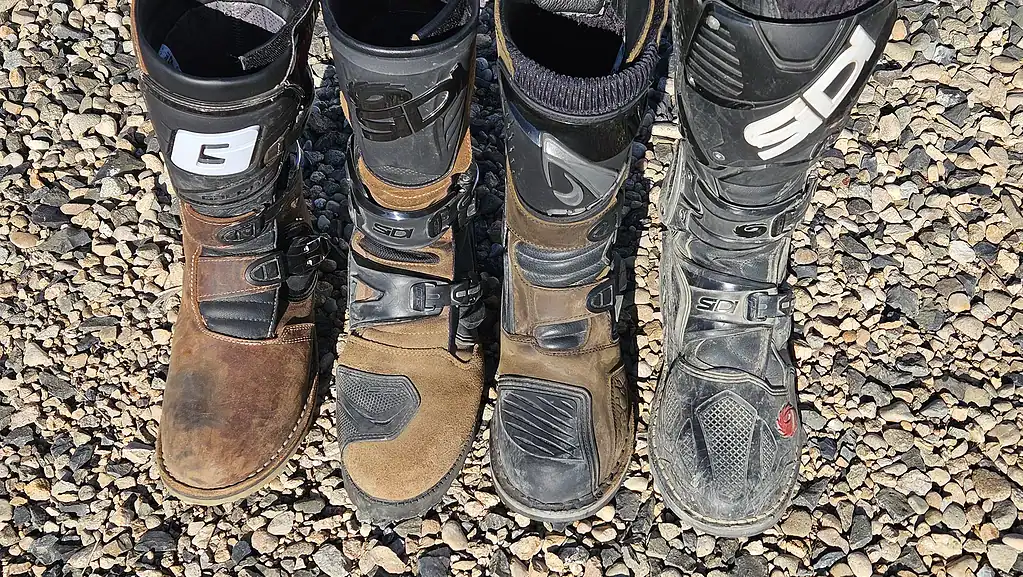
I joke about ‘adventure slippers’ in some classes, usually in reference to the Forma Adventure Boot. This is currently the only boot marketed to adventure riders while offering nearly zero protection for off-road riding. The Forma brand is not the only brand that does this. Many boots marketed as “adventure” boots are really just touring boots that look rugged. They are comfortable, stylish, and easy to walk in, but more often than not, offer next to nothing in protection.
I am not saying that the Forma Adventure, Sidi Adventure 2, Alpinestars Corozal Adventure, or the Klim Adventure GTX (to name only a few) are not well-made boots, but they are absolutely not proper off-road boots. All these boots have a strong following for good reason, though – they are comfortable to walk in, offer good protection from the elements, look great and are well-built boots, but those qualities don’t make them protective, nor have the benefits of a proper off-road boot. I even own a pair of the Sidi Adventure 2’s, but these are my road-touring boots and I don’t use them for riding off-road.
WHY "ADVENTURE" BOOTS LACK OFF-ROAD PROTECTION
The industry sells boots the same way casual footwear is sold: comfort first. Comfort usually results in three things:
- Softer soles
- More toe flex
- Less ankle and torsional support
The “comfort first” approach is fine when touring is the primary goal and “off-road” riding is defined as a well-maintained gravel road ridden at lower speeds where the rider is likely sitting most of the time and the risk of a fall is very low.
In real off-road environments where riders need to ride at higher speeds, stand to maximize control, and “dirt” includes ruts, mud, sand, water crossings and other serious hazards, this comfort first approach becomes a HUGE liability.
If you’re not sure whether a boot is an off-road capable boot or just looks the part, try it on. If the boot feels like it would be comfortable to take on a walk, you can shift normally, and it doesn’t feel overly restrictive, this boot is not going to protect you when a 500lb bike lands on your foot on rough terrain.
COMMON INJURIES MOST RIDERS DON'T SEE COMING
Some of the most serious foot injuries don’t happen in dramatic crashes. They happen when:
- You clip a hidden stump with your toe
- A rock catches your foot as you pass
- The bike falls on your ankle
- You put your foot down on loose terrain and roll an ankle
- You put your foot down while moving and it gets caught on luggage or a passenger peg
One particularly nasty injury Brian mentioned is a Lisfranc injury, caused by excessive toe flex during frontal impacts. It’s common for off-road riders, severe, and often career-ending for athletes.
Stiffer soles and reduced toe flex in a proper off-road boot dramatically lowers this risk. Very few boots outside of the Enduro/MX category offer protection against this type of injury.
WHY OFF-ROAD BOOTS FEEL AWKWARD AT FIRST, AND WHY THAT'S OKAY
The biggest complaints I hear about proper off-road boots are:
- “I can’t feel the brake”
- “I can’t shift properly”
- “They’re hard to walk in”
These are all temporary and solvable problems.
Solutions:
- Adjust your shift lever and brake pedal (Here’s a video on how to do this).
- Change your riding technique. Off-road riding is not street riding. This is a topic I cover during my classes.
- Give yourself time to adapt to a new feel
Every rider who sticks with proper boots eventually reaches the same conclusion: “I don’t even notice them anymore.”
Once that happens, softer (Adventure) boots start to feel unsafe.
THE MYTH OF THE PERFECT BOOT
Every boot involves compromise.
You can find a perfect boot if it only has to do one job in a single environment, but that is not reality.
To maximize protection and stay dry, you want to buy a waterproof top-tier MX boot. It will be dry and protective when you start your ride, but once you start sweating, your feet and boots will be wet from the inside.
If you pick a boot with a smooth sole to move easily on the footpegs, as soon as you have to push your bike or walk, it’s no longer ideal.
• Adventure boots focus on comfort and walking grip
• MX boots focus on impact protection and control
• Enduro boots compromise between protection and mobility
• Trials boots focus on mobility
• Street boots focus on comfort and slide protection
As you can see, each boot has a focus and a compromise.
Adventure boots are most affected by compromise since they are tasked to cover almost every aspect of riding – from street slides to comfort touring and walking, to standing on pegs off-road, to providing protection against rough terrain and heavy motorcycles, as well as being used in hot, cold, dry, and wet conditions.
Because of this wide range of tasks, ADV boots vary the most on what they focus on. On Forma’s webpage for Dual-Sport and Adventure boot they advertise the Forma Adventure Low, a short, soft-soled boot which offers zero off-road protection and minimal road protection, but does provide extreme comfort when touring. On the same page is the Forma Pilot Enduro, which is a full-protection off-road boot. Sidi advertises the same extremes with the Adventure 2 Low on one end of the spectrum with very little actual off-road protection and the X-Power Enduro on the other end. The right boot for you as a rider starts with you deciding what compromises you are willing to make.
Most experienced adventure riders eventually own two pairs of boots:
- A protective off-road–oriented boot
- A lighter adventure/touring boot
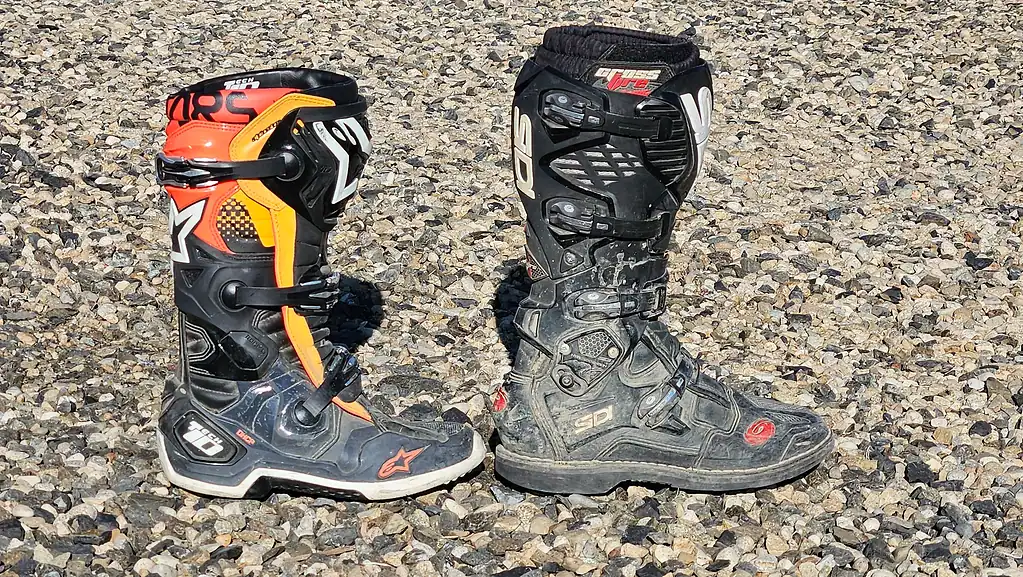
That’s not excess—it’s realism. I currently own Sidi Adventure 2 as my touring boot and a pair of Sidi Crossfire 3’s for the dirt. My wife Christina uses the Forma Terra Evo for ADV touring and the Alpinestars Tech 10’s for the dirt.
You cannot seek maximum comfort/mobility and then argue that you have the same protection as an MX boot. Be honest with yourself.
HOW TO CHOOSE THE RIGHT BOOT (REGARDLESS OF CATEGORY)
Before asking “what boot should I buy,” focus on how it’s built.
Key construction features to evaluate:
- Welded vs glued
- Toe box protection
- Ankle support (hinges matter)
- Torsional rigidity
- Boot height
- Buckles over zippers or Velcro
Welded vs glued: Welded soles are generally stiffer, resulting in better protection and reduced fatigue while standing on the footpegs. Welded soles are also easier to repair, more likely to remain waterproof and can offer superior durability, but are more expensive to manufacture.
Glued soles are generally lighter, can be more flexible and are generally less bulky. They are also less expensive to build, leading to a less expensive boot.
Toe box protection: Toe box protection in some ADV boots is often minimal or even nonexistent. These boots have a stiff, formed leather (or leather substitute) covering the toe with no reinforcement. True toe box protection has an armored cup on the outside of the boot, which is easy to see.
Ankle support: Ankle support comes in two categories: Protection from a rolled ankle and protection from a crushed ankle.
Boots sold as “adventure” boots generally focus on protection from a rolled ankle by offering a mid-calf height boot and enough buckles and Velcro to secure the boot tight against the leg. This helps protect you from rolling an ankle while walking or when putting a leg down to mount, dismount or support the weight of your motorcycle. Low or “Mid” height ADV boots sit too low to offer adequate protection from a rolled ankle.
Enduro and MX boots offer increased rolled ankle support as well as offering crush protection with heavy plastic shielding, hyperextension protection.
Hinges on Enduro and MX boots should be a strong consideration for ADV riders as they will make riding sitting and walking much easier.
Tortional rigidity: Tortional rigidity is a significantly overlooked consideration by most adventure and dual-sport riders. This provides protection from a spiral fracture, ankle injury or knee injury caused when your foot “plants” but your body doesn’t, resulting in a twisting injury or break. Tortional rigidity requires the boot to be taller than mid-calf, and to be able to be buckled tight against your leg (this is normally seen in a 4-buckle boot). It that MOST riders I see who own boots that provide tortional rigidity, they do not wear their boots tight enough to do its job.
Boot height: Low or mid-height boots do not offer adequate protection for adventure, dual-sport or dirt riders. As mentioned above, boot height is necessary for ankle and torsion protection. It can also provide protection from strikes against your motor (think of BMW GS boxer), motorcycle crash bars or some other object along the trail/road or even in an unexpected rapid dismount (crash). The general rule is, the taller the boot the better the protection.
Buckles over zippers or Velcro: Velcro and zippers get the win for convenience and often comfort, but they lose when it comes to protection. Zippers are not common on boots marketed to adventure and dual-sport riders, but Velcro is very common on ADV-style boots. This is generally a one or two buckle setup with Velcro used on the upper flap. This is a compromise of comfort and convenience over protection. Velcro can come loose in a crash and does not offer torsional protection. If the option is available, buckles will always provide a more secure and more protective fit.
Brands that are consistently well-constructed and well-engineered:
- Gaerne
- Sidi
- Forma
- TCX
- Alpinestars
Brand philosophy matters more than marketing claims. One of the disadvantages we have as consumers is we are unable to see the construction that exists below the surface. Generally speaking, choosing a well-known and well-established brand offers some assurance of proper engineering and build quality. However, I have personally seen some well-built boots from unfamiliar brands as well as models of boots from major brand names that I would NEVER use on my own feet. Keep in mind everything in this reference article is meant to be a general guide. I am not trying to either blacklist or endorse any specific brand, model or boot.

WHAT I PERSONALLY LOOK FOR IN AN ADVENTURE TOURING BOOT
If you’re knowingly accepting a compromise in foot protection, be smart about it.
My personal priorities:
- A stiff sole (reduces fatigue, protects from hyperflexion)
- A true mid-calf boot or taller (boots sold as mid-calf are typically shorter than I prefer)
- A stitched/welded sole (this isn’t a dealbreaker but it is my preference)
- The upper boot fits snug to my leg and fits under my riding pants
- I prefer leather over manmade materials as leather normally breaks in better. (If I buy a boot with Gore-Tex, then it must be made of leather).
WHAT I PERSONALLY LOOK FOR IN AN OFF-ROAD BOOT
A good off-road boot can offer maximum protection and still be very comfortable once you have adjusted to the change in flexibility and have spent time breaking in the boot.
My personal priorities:
- Stiff sole (reduces fatigue, protects from hyperflexion)
- Tall upper (the taller the better)
- Stitched/welded sole (this isn’t a dealbreaker but is my preference)
- 4-buckle boot (The upper boot must fit snugly to my leg. The three-buckle Alpinestars Tech 10 is an exception to the four-buckle boot)
- Low toe box height to make it easier to shift when riding an ADV bike
- Reinforced toe box
- Hinged ankle for greater flexibility without giving up protection. This may cost more, but it’s important to me.
Bring your riding pants when shopping or buy your boots and pants together. Fit issues happen even within the same brand.
FIT MATTERS MORE THAN THE LABEL
Focus on EU sizing. Most boots are cut for European sizing and then converted to US sizes. A size 46 is a size 46, regardless of what the US size tag says. This is not always a clean conversion, so know your European shoe size and use the size chart the boot was originally cut for.
I regularly refer riders who have trouble finding a good fit to Brian at Atomic-Moto. Brian has always worked hard to find the best boot for my students and works within price constraints. Good online retailers like Atomic Moto can help you:
- Review foot measurements
- Offer effective guidance based on your riding style
- Support easy returns so you can try on different styles of boots
MY BOTTOM LINE RECOMMENDATION FOR NEW RIDERS
I want to leave you with this if you’re new to adventure riding: Buy more boot than you think you need.
Go past what feels comfortable, but not so far that you won’t wear them. Your risk is highest when you are learning, and that’s exactly when you need the most protection from a boot.
The biggest mistake I see is new off-road riders want to step into this sport gently (financially-speaking) and underspend on boots and tires, resulting in injury. Don’t make this mistake!
FINAL THOUGHTS
We don’t ride motorcycles because they’re safe. We ride because they make us smile.
But smart gear choices let us keep doing this longer with fewer regrets.
Boots are not where you want to cut corners.
See you on the trail.