Menu
Which ADV Tire Should I Buy?
One of the most common questions I’m confronted with by both experience and new adventure riders is “which tires should I use?”
The short answer is: if you plan to ride off-pavement, a 50/50 tire or better may provide a traction advantage. But that short answer is almost never enough.
THE MOST IMPORTANT THING TO UNDERSTAND ABOUT ADV TIRES
You must always give up something to gain something else. There is no single tire that is perfect in all situations. Every tire recommendation I make is a compromise — the goal is to find the compromise that best fits your specific needs, not someone else’s.
Yes, you can mix bias and radial tires on a motorcycle. No, bigger is not better off-road. Yes, 50/50 tires will wear faster than street-focused tires. Yes, 50/50+ tires will be louder on pavement and may feel less stable. Most importantly, remember you must always give something up to gain something else, so there is no single tire that is perfect in all situations.
One of the most common errors riders make when selecting an ADV tire is choosing based on the percentage of where they plan to ride most often, rather than where they need the tire to perform best. If you only ride on dirt 10% of the time but that dirt is extreme, you may need a 30/70 tire, not a 90/10.
If you intend to ride on unpaved roads only 10% of the time, many riders choose a 90/10 tire thinking it means 90% road, 10% dirt. The critical flaw in that logic is this: even if the ratio appears correct, the missing consideration is how difficult that 10% of off-road riding actually is. A fire road and a winch-required jeep trail are both “dirt” — but they are not the same problem.
THERE ARE NO SHORTCUTS TO AN ANSWER
If you ever receive an immediate answer from an instructor or another rider about which tire to use — before they first ask about your bike, your riding, your weight, your weather, and your terrain — they are giving you a generic answer that is not based on your specific needs.
I would not make a decision based solely on someone else’s brand preferences or brand loyalties. Neither should you.
THE QUESTIONS I ASK BEFORE MAKING ANY RECOMMENDATION
There is no simple way to properly answer which tire you should use without gathering more details. Here are the questions I need answered before I can offer a professional recommendation:
Do you have a budget?
Where are you most concerned about having the best performance — ADV travel, street, touring, or dirt?
Which bike are you putting the tire onto?
How much do you weigh?
How much extra weight do you typically ride with — skid plate, crash guards, panniers, gear, passenger, etc.?
In which order do you rank the following: (a) Price, (b) Performance, (c) Longevity, (d) Brand?
What weather do you intend to ride in — temperature, moisture, seasons?
What is the most common surface you intend to ride on?
What is the most challenging surface you intend to traverse?
Which is more important to you: how the tire feels, or how the tire performs?
How aggressive are you when you ride?
Have you ever had formal rider training?
Do you plan to change the tires yourself? If yes, are you proficient at it?
WHY THESE QUESTIONS MATTER
Determining the terrain you ride is most important. Most riders answer the most common surface they ride on, choose a tire for that, and get hurt or stuck by the most challenging surface on that trail. Your tire has to survive your hardest day, not just your average day.
DETERMINING WHAT'S IMPORTANT TO YOU
The four primary factors to consider when purchasing tires are use, performance, price, and brand snobbery. Before I can recommend a tire to anyone, I must know where these factors fall in your personal order of importance.
If you tell me price is important but roll your eyes when I suggest an off-brand tire, this is what I’m talking about. Be honest with yourself; it saves time and money.
1. USE - WHAT DO YOU ACTUALLY NEED THE TIRE TO DO?
The most difficult part here is being honest about what you really want your tires to do. Prepare your tire for the greatest challenge you will encounter. Be honest about the most difficult environment you intend to ride.
I have ridden track days on 50/50 tires and ridden the Backcountry Discovery Routes on 90/10s. Neither is recommended if you have a choice. But they demonstrate that a skilled rider can manage with less-than-ideal tires. The question is whether you want to rely on skill to compensate for tire choice, or whether you want the tire to serve the terrain.
A COMMON MISTAKE I SEE
I often get students who buy the Dunlop Trailmax Mission believing it is as capable off-pavement as a 50/50 tire, or worse, have been convinced that their 70/30 tire IS a 50/50. The Mission is a good tire — but if you are looking for a strong off-road performer on loose surfaces, this type of tire will not work for you. Equally, if you buy the Dunlop Trailmax Raid and expect it to last on the interstate or be quiet on the street, you will be disappointed. There is always a compromise. Know what you are buying.
2. PERFORMANCE - WHERE DO YOU NEED THE MOST TRACTION?
With rare exception, nothing is ever gained without something being lost. Some tires are outstanding at one thing and merely acceptable at others. Understanding exactly which trade-off serves you best requires honest self-assessment of where you spend time and where you are most concerned about grip.
TIRE EXAMPLE
STRENGTH
WEAKNESS
BEST FOR
Heidenau K60 Scout
Exceptional longevity — lasts a very long time
Marginal in most other aspects — traction on difficult terrain is limited
Long-distance touring through South America — you won’t need to buy tires along the way
Michelin Anakee Wild
Michelin Anakee Wild Performs above average both on and off pavement — a genuine dual performer
Very short lifespan — you will replace it more often than most competitors
Training classes, routes with both technical dirt and highway sections, riders who prioritize traction over longevity
Dunlop Trailmax Mission
Longevity on highway and dry unpaved surfaces; quiet on pavement
Not a true off-road performer — traction on loose surfaces limited
Skilled riders who spend most time on pavement and can use technique to compensate off-road
Dunlop Trailmax Raid
Strong off-road performer — aggressive enough for serious ADV terrain
Noisy on pavement, wears faster on highway, less comfortable on road
Riders who prioritize off-road performance and accept pavement trade-offs
Motoz Tractionator RallZ
Very aggressive off-road, rally-inspired design
Can become difficult on wet pavement — one of the more demanding tires in wet conditions on roads
Technical off-road riding, riders prioritizing maximum dirt traction
Michelin Anakee 3
One of the best street-focused ADV tires in wet pavement conditions
Out of its element in the dirt — not a serious off-road option
Predominantly road touring, wet climates, riders who rarely go off-pavement
Tire Size and Contact Area. No, Bigger Is Not Always Better Off-Road
Most unpaved surfaces benefit from a narrower contact area. This is one reason I generally recommend using the smallest tire that properly fits your rim size. As an example, the BMW R1250GS comes stock with a 170/60-17 tire on a 4.25″ rim — but a 150/70-17 on the same rim is also a proper fit. If your goal is improved off-road performance, the 150/70-17 offers an elongated (rather than wide, flat) contact patch that bites into loose surfaces better, while also reducing unsprung weight — which improves suspension function, braking, and acceleration.
These benefits from reduced unsprung weight apply on paved roads too. Manufacturers generally install the largest tire possible for sales and visual appeal, not performance. A rare exception is the Ducati DesertX, which comes stock with a 150/70-18 (the smallest tire that properly fits that rim), prioritizing performance over aesthetics.
A CONTACT AREA SURPRISE
While researching my video project on tire contact printing, I discovered that a 140/80-17 Shinko 705 on a BMW F800GS had a greater contact area than a Shinko 705 170/70-17 on an R1250GS. A larger tire size does not automatically mean more contact area. Construction factors (including compound) affect the actual contact patch significantly. This was confirmed through repeated testing while monitoring tire temperature, ambient air temperature, tire loading, and tire pressure.
2. PRICE - LIFECYCLE COST VS PURCHASE PRICE
Before choosing a cheaper tire or skipping a more expensive one, consider lifecycle cost rather than sticker price. Lifecycle cost accounts for the total expense over the tire’s full life — including installation, shipping, disposal fees, and taxes.
If you buy a tire priced 50% less than its competitor but it lasts half as long, the two tires are equal in lifecycle cost on paper. But once you factor in installation, shipping, and the convenience of not stopping mid-trip to change tires, the calculation often favors the more expensive, longer-lasting option.
A REAL EXAMPLE: MOTOZ VS. KENDA
The Motoz Tractionator Adventure costs over double the price of the Kenda K784 Big Block — but it also boasts almost twice the lifespan. If you pay for tire changes, the Motoz may actually be cheaper per mile when all costs are included.
However, if you change your own tires, or if your tires age out before they wear out, the Kenda gives you the performance advantage of a softer compound plus the opportunity to have “fresh” knobbies for the dirt more often. Neither answer is universally correct — it depends on your situation.
If you fail to purchase tires that best meet your needs, you may end up replacing them prematurely — as is often the case with OEM tires. Researching what you value most will help you establish a realistic budget and spend more wisely.
An example close to my heart is the new ADV rider who chooses to attend one of my training classes but doesn’t purchase the tires that will help them get the most from the experience. A tire that offers traction advantages will help a student build confidence more rapidly — proper tires reduce the number of tip-overs and slide-outs, and give more latitude for the errors that are a normal part of learning. Riders who invest significant time and money in training with me are best served by equipping their motorcycle with tires suited to developing their riding skills, not just tires that were already on the bike.
LEARNING TO READ ADV TIRE BIAS RATINGS
When searching for an ADV tire, you will immediately encounter split designations such as 60/40. Understanding exactly what these numbers mean — and where they can mislead you — is foundational to making a good tire decision.
What the Numbers Mean
The first number in a split designation represents the street bias. A 60/40 tire is biased toward better street performance than off-road performance. A 50/50 tire is designed to perform comparably on both surfaces. A 90/10 tire is predominantly a street tire with minimal off-road capability.
WATCH THE ORDER - IT CAN BE REVERSED
Manufacturers are generally consistent with the street/dirt order (street first), but forums and bike shops may list the largest bias first regardless of which it is. A “90/10” reference could mean 90% street / 10% dirt OR 90% dirt / 10% street depending on where you read it.
In less-professional settings, always verify which order is being referenced. A quick look at the tire tread pattern will usually make it self-explanatory.
The Tread-Gap Method: How to Quickly Assess Any Tire
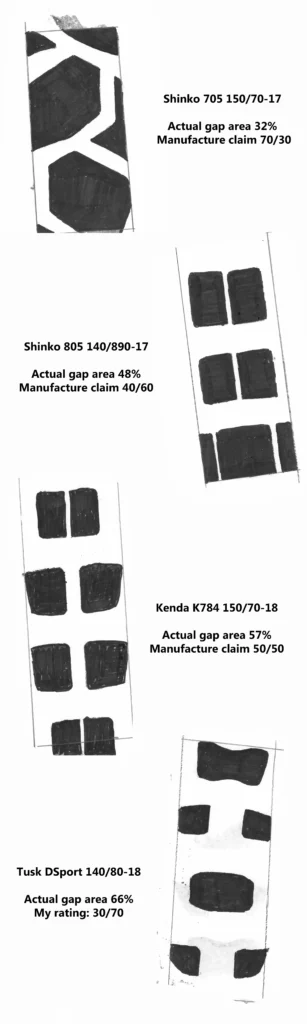
The simplest and most reliable way to quickly assess the actual street/dirt bias of a tire follows the same method manufacturers use to assign ratings: the tread-gap method. Visually or physically measure the open, non-contact area of the tire. These are the open spaces where the knob or tread does not touch a hard surface. This is the gap between tread blocks.
Gap / Contact
Rating
What It Means
Examples
~10% gap / 90% contact
90/10 — Street aggressive
Very limited off-road capability; suitable for hard-packed gravel
Pirelli Scorpion Trail II, Michelin Anakee 3
~30% gap / 70% contact
70/30 — Street-biased
Comfortable on pavement; can handle dry trails; limited in wet or loose terrain
Shinko 705, Continental TKC70, Metzeler Tourance
~50% gap / 50% contact
50/50 — Dual purpose
Offering good capabilities for both street and dirt but seldom excelling at either.
Michelin Anakee Wild, Motoz Tractionator Adventure, Pirelli Scorpion Rally
~70%+ gap / 30% or less contact
30/70 – Dirt biased
Optimized for off-road — louder, fast-wearing on pavement, highest dirt traction
Motoz Tractionator RallZ, Continental TKC80, Kenda K784 Big Block
~90%+ gap / 10% or less contact
10/90 — Dirt aggressive
Street-legal dirt tire, limited availability in larger tire sizes on large ADV bikes
Dunlop D606, Pirelli MT21, Tusk DSport
TREAD GAP IS NOT THE ONLY FACTOR
A good example of how tread gap can mislead: the Mitas Enduro Trail (E-07) visually appears more street-focused with a tighter gap pattern than the Mitas Enduro Trail+ (E-07+). The Trail+ has larger blocks, bigger gaps, and looks more aggressive, yet the Trail (rated 50/50) performs better in nearly all off-pavement environments than the more aggressive-looking Trail+ (rated 60/40).
Tread gap determines thrust-based traction — grip on soft surfaces such as mud, sand, and loose dirt. But on surfaces that require friction for traction (slick rock, wet hardpack, wet pavement) gap matters far less than compound and construction. The two main types of off-road traction are friction and thrust, and different surfaces demand different approaches.
Matching Bias to Terrain Difficulty
One way to think about the bias you need is to assess how closely the dirt you intend to ride resembles a paved surface:
- A gravel road is perhaps 90% similar to a paved road in riding difficulty — a 90/10 tire is likely sufficient
- An OHV trail intended for side-by-sides or 4WD vehicles may be 50% or less equal to pavement, a 50/50 tire is more appropriate
- A jeep trail or single track, look for street-legal knobbies; few ADV tires are aggressive enough
Generally, once the trail becomes challenging enough to be called a jeep trail or singletrack, you should be looking for the most aggressive street-legal option available for your wheel size. There are very few exceptions where an ADV tire is more aggressive than a 50/50 knobby — and those tires are typically only available in smaller sizes for dual-sport bikes.
A Word on Misleading Tire Names
The Pirelli Scorpion Trail II tires (listed as a 95/5) are sold as “trail” tires — despite being very well suited for the road or racetrack and poorly suited for anything off-pavement other than dry, hard-packed surfaces. The name implies off-road capability that the tire’s actual construction does not deliver. Always look at the tread, not the name.
ADDITIONAL CONSIDERATIONS FOR CHOOSING A TIRE
Beyond the core bias decision, the following factors can significantly alter which tire is right for you.
A. Your Motorcycle
Different tire models come in specific sizes, meaning a tire I might recommend may not be available for your motorcycle. Also, the same tire in different sizes can perform very differently. Besides size and weight, how much power the motorcycle produces can alter the recommendation. Very high-horsepower motorcycles like the Ducati Multistrada V4 S (170 hp) can quickly wear out a highly dirt-focused tire while also having more limited tire fit options.
AN INSTRUCTIVE EXAMPLE — THE TKC80 BY RIM SIZE
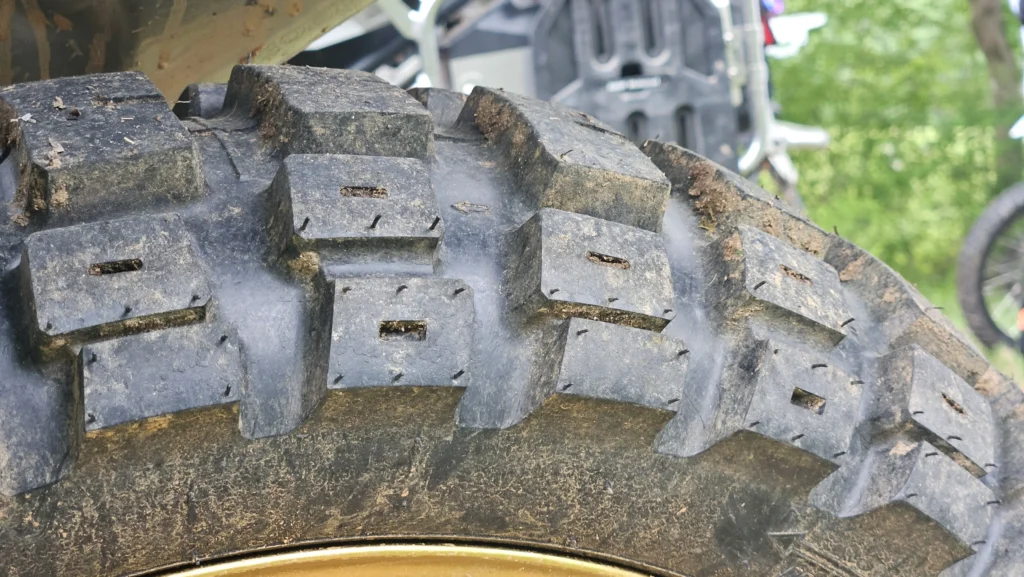
A Continental TKC80 on a 21″ rim performs quite well on pavement, but lacks the off-road performance that the same tire on a 19″ rim has. The 19″ size offers a much larger gap between traction knobs than the 21″ size, making it significantly more capable in the dirt despite being the “same” tire.
AN INSTRUCTIVE EXAMPLE
A Continental TKC80 on a 21″ rim performs quite well on pavement, but lacks the off-road performance that the same tire on a 19″ rim has. The 19″ size offers a much larger gap between traction knobs than the 21″ size, making it significantly more capable in the dirt despite being the “same” tire.
B. Weight of the Loaded Motorcycle
How much you weigh and how much weight you add to your motorcycle matters more than most riders consider. You need to ensure your tires carry the proper weight rating. Using the GVWR (Gross Vehicle Weight Rating) is the simplest approach, or add up the weight of yourself, the bike with fuel, and all extras — crash protection, panniers, gear, passenger, and travel gear.
Weight ratings are seldom an issue when sizing tires to stock rims but can become critical if you have a modified bike with narrower rims than factory. Beyond load rating and traction, a heavier load may favor a bias-ply tire for better rim protection, while a lighter load may allow a radial for a smoother ride and higher traction levels.
C. Feel vs. Performance
It is difficult to be truly honest when asking yourself whether how the tire feels or how it performs is more important. More than once I have helped a rider select the tire they said they wanted — performance prioritized — only to have them return unhappy with how the tire feels. A tire with maximum cornering traction is not always the one that feels most planted. Be honest with yourself when answering this question, or you may be very disappointed.
Generally speaking, larger tread blocks and shallower tread depth provide more stable handling on hard surfaces. Smaller blocks, deeper tread, and wider gaps can provide significantly better traction in soft terrain, but at the expense of a bike that feels unstable on pavement.
THE ANAKEE WILDS
The Michelin Anakee Wild can perform very well on both pavement and dirt, but when pushed hard or taken above 85 mph on the highway, it can feel much less stable. The bike is actually stable, but the pronounced feel (weave) of directional correction from rake and trail can be very unnerving to riders who aren’t expecting it. Even though the tire is performing correctly, the feel doesn’t match the performance. For some riders, that’s enough to disqualify it.
D. How Aggressive Are You As A Rider?
There is an important distinction between an aggressive rider and a rider who rides aggressively. The question is, how aggressive are YOU, not necessarily how aggressive is the terrain.
Rider Type
Riding Style
What It Means
Aggressive rider
Rides fast and hard, hits hard edges, spins the rear tire, puts high physical stress on the tire
Benefits from a harder compound and bias-ply construction to protect rims and resist wear from spinning. Radials may not hold up.
Rider who rides aggressively
Rides fast but with skill — reads terrain to avoid hard hits, uses clutch and throttle mastery to minimize wheel spin in low-traction environments
May benefit from softer-sidewall radials, giving up rim protection in exchange for a smoother ride and higher traction levels. Technique compensates for tire limitations.
E. Have You Had Formal Rider Training?
Formal rider training can directly affect which tire best serves you. My training is “traveler” based rather than speed-focused. I teach how to ride in a way that reduces risk to you and your motorcycle while conserving energy. Technique over brute force means far less impact and no unnecessary wheel spin, which means you can often select a tire with softer sidewalls and reduced traction in situations where an untrained rider would rely on the tire to compensate for poor technique.
A trained rider can get more out of a less aggressive tire. An untrained rider may need a more forgiving, traction-focused tire to compensate for technique gaps. Neither situation is wrong — it just affects the decision.
F. Are You Changing Your Own Tires?
Not all tires are equal in difficulty when mounting. Some tires can be notably harder than others. If you are new to tire changes, choosing a more pliable tire such as the Kenda K784 Big Block over a heavier sidewall tire like the Heidenau K60 Ranger could influence your decision. For those skilled at changing tires, this is no longer a factor.
If tire changes are something you want to learn, Bret created a video on this. Learning to change your own tires is a genuine asset for long-distance and remote ADV riding. It removes a logistical dependency and is a faster roadside solution than waiting for a shop.
G. What Weather Will You Be Riding In?
Determining the worst weather you may ride in is critical — not just the average weather. A dry trail can easily be ridden on a 70/30 tire like the Shinko 705 or Continental TKC70, but add rain to that same trail and it can quickly become not just challenging but dangerous.
Condition
TIRE CONSIDERATION
Wet pavement / rainy climate
Street-focused tires like the Michelin Anakee 3 excel here. Many dirt-focused tires have compounds ideal for off-road longevity but become “festive at best and dangerous at worst” on wet pavement.
Dry, hard-packed off-road
A 70/30 tire can often handle this adequately. The additional gap of a 50/50 tire is less critical when the surface is firm. |
Wet, loose off-road (mud/clay)
This is where gap matters most. Even with the most aggressive ADV tire like the Motoz Tractionator RallZ, a wet trail can make a normally easy ride very difficult. A 70/30 tire in this environment can become genuinely dangerous.
Hot, dry desert
Heat accelerates wear, especially on softer compounds. A longer-wearing tire may be worth the traction trade-off in pure desert riding where the terrain is consistent.
Multi-season mixed touring
Prioritize wet-weather capability on-road combined with adequate off-road traction. The Michelin Anakee Wild and similar genuine 50/50 tires are popular here for their breadth of competence despite shorter lifespan.
MY FINAL THOUGHTS
There is no single right answer. The right tire for your adventure is the one that best balances your specific needs — your terrain, your weather, your bike, your weight, your skill level, and your budget — after honest self-assessment of each factor.
The worst tire decision you can make is choosing based on what someone else on a forum rides, or what came on your friend’s bike. Their answers to the questions above are different from yours. Start with the questions and build toward the answer.